BBK 28.903
F50
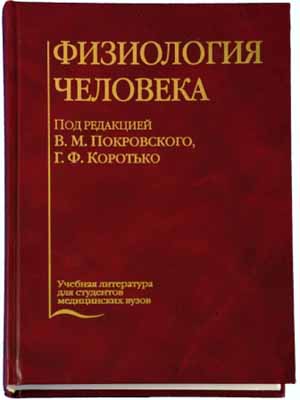
Human Physiology: Text-book/ Edited by V.M. Pokrovskii,
G.F. Korot'ko. - 2-nd edition, revised and complete.- Ì.: ÎÀÎ Publishing house "Medicina", 2007. - 656 p.: il.: [2] l. il. - Academic books. For students of med. institues).
ISBN 5-225-04729-7
The second edition of the text-book (first edition was released in 1997 and 3 times stereotypically replicated in 1998, 2000 and 2001) and revised in accordance with the recent scientific advances. New facts and concepts are presented. The authors of the text-book - are eminently qualified specialists in appropriate areas of physiology. The special attention was paid to description of the methods of the quantitative assessment of functional state of the most important systems of human organism. The text-book meets the requirements of the program, approved by Ministry of Health of Russia. For students of medical institutes of higher education and faculties.
Academic books for students of medical institutes
Human Physilogy
Edited by
V.M. Pokrovskii, G.F. Korot'ko
Second edition, revised and complete.
Recommended by administration of scientific and educational medical institutions of Ministry of Public Health of Russian Federation as a text-book for students of medical institutes
CONTENTS
Introduction to the second edition
Introduction to the first edition
Chapter 1. Physiology: subject, methods, significance for medicine. Short history – V.M.Pokrovskii, G.F.Korot'ko
1.1. Physiology, its substance and role in the system of medical education
1.2. Coming into being and development of physiological methods of research
1.3. Principles of function control organization – V.P.Degtyaryov
1.3.1. Control in living organisms
1.3.2. Selfregulation of physiological functions
1.3.3. Control system organization. Functional systems and their interaction.
1.4. Organism and environment. Adaptation.
1.5. Short history of physiology
Chapter 2. Excitable tissues.
2.1. Physiology of excitable tissues – V.I.Kobrin
2.1.1. Structure and basic functions of cell membrane
2.1.2. Basic characteristics of cell membranes and ion channels
2.1.3. Methods of excitable cells study
2.1.4. Rest potential
2.1.5. Action potential
2.1.6. Electric power effects on excitable tissues
2.2. Neural tissue physiology – G.A.Kuraev
2.2.1. Structure and morphofunctional neuron classification
2.2.2. Receptors. Receptor and generated potential
2.2.3. Afferent neurons
2.2.4. Association neurons
2.2.5. Efferent neurons
2.2.6. Neuroglia
2.2.7. Conduction of excitement via nerves
2.3. Synapses physiology - G.A.Kuraev
2.4. Physiology of muscular tissue
2.4.1. Skeletal muscles – V.I.Kobrin
2.4.1.1. Skeletal muscle fibers classification
2.4.1.2. Functions and characteristics of skeletal muscles
2.4.1.3. Mehanism of muscle contraction
2.4.1.4. Regimes of muscle contractions
2.4.1.5. Work and power of a muscle
2.4.1.6. Energetics of muscle contractions
2.4.1.7. Heat buildup at muscle contraction
2.4.1.8. Skeletal-muscle interaction
2.4.1.9. Evaluation of muscle system functional state in human
2.4.2. Smooth muscles – R.S.Orlov
2.4.2.1. Classification of smooth muscles
2.4.2.2. Contraction of smooth muscles
2.4.2.3. Innervation of smooth muscles
2.4.2.4. Functions and characteristics of smooth muscles
2.5. Physiology of glandular tissue – G.F.Korot'ko
2.5.1. Secretion
2.5.2. Multifunctional secretion
2.5.3. Secretion cycle
2.5.4. Biopotential of glandulocytes
2.5.5. Regulation of glagulocytes secretion
Chapter 3. Nervous regulation of physiological functions.
3.1. Mechanisms of the central nervous system activity – O.G.Chorajan
3.1.1. Analysis of the central nervous system functions
3.1.2.Reflex principle of functions regulation
3.1.3. Inhibition in the central nervous system
3.1.4. Nervous centers characteristics
3.1.5. Principles of integration and coordination in the central nervous system activity
3.1.6. Neuron complexes
3.1.7. Hematoencephalitis barrier
3.1.8. Cerebrospinal fluid
3.1.9. Cybernetics elements of nervous system
3.2. Physiology of the central nervous system - G.A.Kuraev
3.2.1. Spinal cord
3.2.1.1. Morphofunctional organization of the spinal cord
3.2.1.2. Peculiarities of the spinal cord neuron organization
3.2.1.3.Spinal cord conduction pathways
3.2.1.4. Spinal cord reflex functions
3.2.2. Brain trunk
3.2.2.1. Medulla oblongata
3.2.2.2. Pons
3.2.2.3. Midbrain
3.2.2.4. Reticular formation of the brain trunk
3.2.2.5. Diencephalon
3.2.2.5.1. Thalamus
3.2.2.6. Cerebellum
3.2.3. Limbic system
3.2.3.1. Hippocampus
3.2.3.2. Amygdaloid body
3.2.3.3. Hypothalamus
3.2.4. Nuclei basalis
3.2.4.1. Caudate nucleus. Putamen
3.2.4.2. Pale globe
3.2.4.3. Claustrum of insula
3.2.5. Cerebral cortex
3.2.5.1. Morphofunctional organization
3.2.5.2. Sensory areas
3.2.5.3. Motor areas
3.2.5.4. Associative areas
3.2.5.5. Electric manifestation of the cerebral cortex activity
3.2.5.6. Interhemispheric interaction
3.2.6. Coordination of movements – V.S.Gurfinkel, J.S.Levik
3.3. Physiology of the autonomous (vegetative) nervous system – A.D.Nozdrachev
3.3.1. Functional structure of the autonomous nervous system
3.3.1.1. Sympathetic part
3.3.1.2. Parasympathetic part
3.3.1.3. Metasynpathetic part
3.3.2. Peculiarities of the autonomous nervous system construction
3.3.3. Autonomous (vegetative) tone
3.3.4. Synaptic conduction of excitation in the autonomous nervous system
3.3.5. Influence of the autonomous nervous system on the functions of tissues and organs
Chapter 4. Hormonal regulation of physiological functions.– V.A.Tkachuk, O.E.Osadchy
4.1. Principles of hormonal regulation
4.2. Analyses
4.3. Formation, removal from endocrine cells, blood transport and mechanism of action of hormones.
4.3.1. Hormone synthesis
4.3.2. Hormones removal from cell producers and hormone transport through blood
4.3.3. Molecular mechanisms of hormones action
4.4. Endocrine glands and physiological role of their hormones
4.4.1. Hypophisis
4.4.2. Thyroid gland
4.4.3. Parathyroid gland
4.4.4. Adrenal glands
4.4.5. Pancreas
4.4.6. Sexual glands
4.4.7. Endothelium as endocrine tissue
Chapter 5. Blood system. – B.I.Kuznik
5.1. Blood system concept
5.1.1. Main blood functions
5.1.2. Amount of blood in the organism
5.1.3. Blood plasma composition
5.1.4. Physical and chemical characteristics of blood
5.2. Formal blood elements
5.2.1. Erythrocytes
5.2.1.1. Hemoglobin and its compounds
5.2.1.2. Color index
5.2.1.3. Hemolysis
5.2.1.4. Erythrocytes functions
5.2.1.5. Erythron
5.2.2. Hemopoiesis
5.2.2.1. Basic conditions for normal hemopoiesis
5.2.2.2. Hemopoiesis physiology
5.2.2.3. Hemopiesis providing factors
5.2.3. Leukocytes
5.2.3.1. Physiological leukocytes. Luekopenia
5.2.3.2. Leucocytic formula
5.2.3.3. Characteristics of some types of leukocytes
5.2.3.4. Physiology of leucopoiesis
5.2.3.5. Leucopoiesis providing factors
5.2.3.6. Non-specific resistance
5.2.3.7. Immunity
5.3. Blood groups
5.3.1. ABO system
5.3.2. Rhesus system (Rh-hr) and others
5.3.3. Blood groups and morbidity
5.4. Thrombocytes
5.5. Homeostasis system
5.5.1. Vessel-thrombocytes homeostasis
5.5.2. Blood coagulation process
5.5.2.1. Plasma and cell factors of blood coagulation
5.5.2.2. Mechanisms of blood coagulation
5.5.3. Natural anticoagulants
5.5.4. Fibrinolysis
5.5.5. Blood coagulation and fibrinolysis
5.6. Instrumental analysis of the blood system
Chapter 6. Blood and lymph circulation. – V.M.Pokrovskii, G.I.Kositsky
6.1. Heart activity
6.1.1. Electrical phenomenon in the heart, origin and conduction of excitement
6.1.1.1. Electrical activity in myocardium cells
6.1.1.2. Function of conduction of excitement
6.1.1.3. Dynamics of myocardium excitation and extrasystole
6.1.1.4. Electrocardiogram
6.1.2. The pressure function of the heart
6.1.2.1. Cardiac cycle
6.1.2.2. Cardiac throw
6.1.2.3. Mechanical and sound manifestations of cardiac activity
6.1.2.4. Analysis of heart functions
6.1.3. Regulation of cardiac activity
6.1.3.1. Intracardiac regulatory mechanisms
6.1.3.2. Extracardiac regulatory mechanisms
6.1.3.3. Influence of the central nervous system on the cardiac activity
6.1.3.4. Reflex regulation of cardiac activity
6.1.3.5. Conditioned reflex regulation of cardiac activity
6.1.3.6. Humoral regulation of cardiac activity
6.1.3.7. Integration of mechanisms of the cardiac activity regulation
6.1.4. Endocrine cardiac function
6.2. Functions of the vessel system
6.2.1. Main principles of hemodynamics
6.2.2. Blood flow through vessels. Classification of vessels
6.2.2.1.Arterial blood pressure and peripheric resistance
6.2.2.2. Arterial pulse
6.2.2.3. Volumetric blood flow rate
6.2.2.4. Blood movement in capillaries. Microcirculation
6.2.2.5. Blood movement in veins
6.2.2.6. Time of blood circulation
6.2.3. Regulation of blood movement through vessels
6.2.3.1. Vessels innervation
6.2.3.2. Vasomotoral center
6.2.3.3. Humoral influences on vessels
6.2.3.4. Physiological systems of regulation
6.2.3.5. Redistributional reactions in the system of regulation of blood circulation
6.2.3.6. Regulation of volume of circulating blood. Blood depot.
6.2.3.7. Changes of the cardiovascular activity at work
6.2.4. Regional blood circulation – J.A.Hananashvili
6.2.4.1. Coronary blood circulation
6.2.4.2. Blood supply of brain and spinal cord
6.2.4.3. Pulmonary blood circulation
6.3. Lymphokinesis - R.S.Orlov
6.3.1. Lymphatic system
6.3.2. Lymph formation
6.3.3. Lymph composition
6.3.4. Lymph movement
6.3.5. Lymphatic system functions
Chapter 7. Respiration. – A.G.Chuchalin, V.M.Pokrovskii
7.1. Essence and stages of respiration
7.2. External respiration – A.V.Chernjak
7.2.1. Biomechanics of respiratory movements
7.2.2. Respiratory muscles
7.2.3. Change of pressure in lungs
7.2.4. Pleural pressure
7.2.5. Elastic properties of lungs
7.2.6. Extensibility of lungs
7.2.7. Elastic properties of chest
7.2.8. Resistance in respiratory system
7.2.9. Work of respiration
7.3. Lungs ventilation – Z.R.Ajsanov, E.A.Maligonov
7.3.1. Lungs volumes and capacities
7.3.2. Quantitative characteristics of lungs ventilation
7.3.3. Alveolar ventilation
7.4. Gas exchange and gas transportation – S.N.Avdeev, E.A.Maligonov
7.4.1. Gas diffusion
7.4.2. Oxygen transportation
7.4.3. Oxyhemoglobin dissociation ñurve
7.4.4. Oxygen delivery and tissue oxygen consumption
7.4.5. Carbon dioxide transport
7.5. Regulation of eternal respiration – V.F.Pjatin
7.5.1. Respiratory center
7.5.2. Reflex regulation of respiration
7.5.3. Co-ordination of respiration with other functions of an organism
7.6. Peculiarities of respiration during exercise and at changed partial gas pressure - Z.R.Ajsanov
7.6.1. Respiration at exercises
7.6.2. Respiration at lifting
7.6.3. Respiration with pure oxygen
7.6.4. Respiration at high pressure
7.7. Non-respiratory lungs function – E.A.Maligonov, A.G.Pohot'ko
7.7.1. Protective functions of respiratory system
7.7.1.1. Mechanical factors of protection
7.7.1.2. Cellular factors of protection
7.7.1.3. Humoral factors of protection
7.7.2. Metabolism of biologically active substance in lungs
Chapter 8. Digestion.– G.F.Korot'ko
8.1. Hunger and satiation
8.2. Essence of digestion and its organization
8.2.1. Digestion and its importance
8.2.2. Types of digestion
8.2.3. Conveyer principal in digestion organization
8.3. Digestive functions
8.3.1. Secretion of digestive glands
8.3.2. Motor function of digestive tract
8.3.3. Suction
8.4. Regulation of digestive functions
8.4.1. Digestive functioning control
8.4.2. Role of regulatory peptides and amines in digestive tract functioning
8.4.3. Blood supply of digestive tract and its functional activity
8.4.4. Periodical activity of digestive apparatus
8.5. Methods of digestive functions studying
8.5.1. Experimental methods
8.5.2. Analysis of digestive functions in human
8.6. Digestion in oral cavity and swallowing
8.6.1. Food intake
8.6.2. Mastication
8.6.3. Salivation
8.6.4. Swallowing
8.7. Digestion in the stomach
8.7.1. Secretory function of the stomach
8.7.2. Motor functioning of the stomach
8.7.3. Evacuation of the stomach contents in duodenum
8.7.4. Vomiting
8.8. Digestion in the small intestine
8.8.1. Secretion of the pancreas
8.8.1.1. Formation, composition and properties of pancreatic juice
8.8.2. Bile production and biliary excretion
8.8.3. Intestinal secretion
8.8.4. Cavernous and parietal hydrolysis of the nutrients in small intestine
8.8.5. Motor functioning of the small intestine
8.8.6. Absorption of the different substances in small intestine
8.9. Functions of the large intestine
8.9.1. Entry of intestinal chyme in large intestine
8.9.2. Role of the large intestine in digestion
8.9.3. Motor activity of the large intestine
8.9.4. Gases of the large intestine
8.9.5. Defecation
8.9.6. Microflora of digestive tract
8.10. Liver functions
8.11. Digestive functions and motor activity of the human
8.11.1. Influence of hypokinesia
8.11.2. Influence of hyperkinesias
8.12. Non-digestive functions of digestive tract
8.12.1 Excretive functioning of digestive tract
8.12.2. Participation of digestive tract in water-salt metabolism
8.12.3. Endocrine function of digestive tract and secretion consisting of secret of the physiologically active substances
8.12.4. Incretion (endosecretion) of ferments by digestive glands
8.12.5. Immune system of digestive tract
Chapter 9. Metabolism and interchange of energy. Feeding.– V.M.Pokrovskii
9.1. Metabolism
9.1.1. Protein metabolism
9.1.2. Lipid metabolism
9.1.3. Metabolism of carbohydrates
9.1.4. Metabolism of mineral salts and water
9.2. Energy transformation and general metabolism
9.2.1. Methods of investigations of energy exchange
9.2.1.1. Direct calorimetry
9.2.1.2. Indirect calorimetry
9.2.1.3. Investigations of gross metabolism
9.2.3. Basal Metabolism
9.2.4. The surface rule
9.2.5. Energy exchange at physical labor
9.2.6. Energy exchange at brain work
9.2.7. Specific dynamic food action
9.2.8. Regulation of energy exchange
9.3. Feeding – G.F.Korot'ko
9.3.1. Alimentary substances
9.3.2. Theory of feeding
9.3.3. Feeding norms
Chapter 10. Thermoregulation.- V.M.Pokrovskii, J.M.Perov
10.1. Thermoregulation as a factor of homeostasis
10.2. Types of thermoregulation
10.3. Temperature of human's body and its parts
10.4. Heat buildup - chemical thermoregulation
10.5. Heat irradiation -physical thermoregulation
10.6. Regulation of isothermia
10.7. Hypothermia
10.8. Hyperthermia
Chapter 11. Secretion. Renal physiology.– J.V.Natochin
11.1. Overall performance
11.2. Kidneys and their functions
11.2.1. Analysis of kidneys functions
11.2.2. Nephron and its blood supply
11.2.3. Process of uropoiesis
11.2.3.1. Glomerular filtration
11.2.3.2. Tubular reabsorption
11.2.3.3. Tubular secretion
11.2.4. Deinition of the size of renal plasma and blood flow
11.2.5. Synthesis of substances in kidneys
11.2.6. Osmotic dilution and reduction of the urine
11.2.7. Homeostatic functions of kidneys
11.2.8. Excretory functions of kidneys
11.2.9. Incretory functions of kidneys
11.2.10. Metabolic function of kidneys
11.2.11. Regulation principles of reabsorption and secretion of substances in the renal tubules cells
11.2.12. Regulation of kidneys functioning
11.2.13. Quantity, composition and properties of urine
11.2.14. Urination
11.2.15. After-effects of kidney ablation and artificial kidney
11.2.16. Age-specific peculiarities of structure and function
Chapter 12. Reproductive function. – I.I.Kutsenko
12.1. Sex differentiation
12.2. Pubescence
12.3. Genital behavior
12.4. Physiology of the female sexual organs
12.5. Physiology of the male sexual organs
12.6. Pregnancy physiology
12.7. Physiology of delivery and puerperal period
12.8. Newborn organism adaptation to the intrauterine life conditions
12.9. Lactation
Chapter 13. Sensor systems. – M.A.Ostrovsky, I.A.Shevelev
13.1. General physiology of sensor system
13.1.1. Analysis of sensor system
13.1.2. General principles of sensor systems structure
13.1.3. Principal functions of sensor system
13.1.4. Mechanisms of information processing in sensor system
13.1.5. Sensor system adaptation
13.1.6. Interaction of sensor system
13.2. Particular physiology of sensor system
13.2.1. Optic system
13.2.2. Acoustic system
13.2.2.1. Structure and functions of external and middle ear
13.2.2.2. Structure and functions of internal ear
13.2.2.3. Acoustic functions
13.2.2.4. Acoustic sensations
13.2.3. Vestibular system
13.2.4. Somatosensory system
13.2.4.1. Skin reception
13.2.5. Olfactory system
13.2.6. Taste system
13.2.7. Visceral system
Chapter 14. Integral activity of human's brain. – O.G.Chorajan
14.1. Conditioned reflex base of higher nervous activity
14.1.1. Conditioned reflex
14.1.2. Methods of study of conditioned reflexes
14.1.3. Stages of conditioned reflex creation
14.1.4. Kinds of conditioned reflex
14.1.5. Inhibition of conditioned reflexes
14.1.6. Dynamics of the base conditioned processes
14.1.7. Types of higher nervous activity
14.2. Physiological mechanisms of memory
14.3. Emotions
14.4. Sleep and hypnosis – V.I.Kobrin
14.4.1. Hypnosis
14.5. Psychophysiology foundations
14.5.1. Neurophysiologic foundations of psychic activity
14.5.2. Psychophysiology of the decision making process
14.5.3. Consciousness
14.5.4. Thinking
14.6. Second signaling system
14.7. Principle of probability and "diffusiveness" in higher integrative brain functions
14.8. Interhemispheric asymmetry
14.9. Foundations of chronophysiology – G.F.Korot'ko, M.G.Vodolazhskaja
14.9.1. Biological rhythms
14.9.1.1. Circadian rhythms in human
14.9.2. Autochronometry
14.9.3. Regulation of biological clocks of mammals
Suggested reading
Subject index
